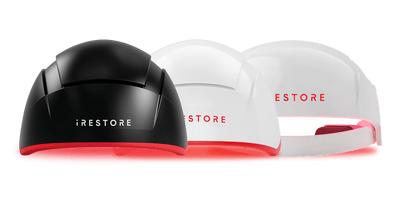


Most research on red light therapy for hair growth centers on visible red wavelengths in the mid-600nm range, including 650nm, 655nm, and 660nm. No strong head-to-head clinical evidence shows that one of these closely spaced wavelengths is universally better than the others.
For shoppers comparing devices, choosing the right red light wavelength for hair growth is less about finding the highest nanometer number and more about whether the device combines an evidence-supported wavelength with appropriate light delivery, scalp coverage, and a treatment protocol designed for hair growth.
What Does Research Show About Red-Light Wavelengths for Hair Growth?
Research on low-level light therapy (LLLT), a form of photobiomodulation, has shown improvements in hair density in people with androgenetic alopecia. A 2021 systematic review and meta-analysis of seven double-blind randomized controlled trials found significantly greater hair density with home-use LLLT devices than with sham treatment, with benefits reported in both men and women.
The evidence does not point to one exact wavelength as the only effective option. Clinical studies have evaluated devices that use several closely spaced visible-red wavelengths, which is why it is more accurate to look at the broader evidence around the mid-600nm region rather than declare a single number universally best.
Laboratory research also helps explain why wavelengths around 650nm receive so much attention. Laboratory research also helps explain why wavelengths around 650nm receive so much attention. In a 2021 study, Yang and colleagues exposed cultured human hair follicles to 650nm red light. The exposure increased follicular-cell proliferation and delayed progression from the active anagen phase toward catagen. RNA sequencing also identified changes in pathways associated with follicular cell activity.
These findings provide useful mechanistic evidence for 650nm, but they do not prove that it produces better clinical results than 655nm or 660nm. More recent expert consensus also supports photobiomodulation as a treatment option for androgenetic alopecia, while the broader literature continues to note differences in devices and treatment protocols across studies.
650nm vs 655nm vs 660nm: Does the Difference Matter?
There is currently no strong head-to-head clinical evidence showing that 650nm, 655nm, or 660nm is inherently better for hair growth. These wavelengths sit only a few nanometers apart within the visible-red spectrum, and research has not established that choosing one over the others produces superior hair-growth outcomes on its own.
650nm has direct experimental evidence in cultured human hair follicles, while 655nm has been incorporated into clinically evaluated and cleared hair-growth systems. Nearby red wavelengths have also been used across photobiomodulation research. The available evidence therefore supports looking at the wavelength as part of the device's complete treatment system rather than treating a 5nm or 10nm difference as the deciding factor.
The available evidence therefore does not support choosing between 650nm, 655nm, and 660nm based on wavelength difference alone.
Why Is 655nm Common in Hair-Growth Devices?
655nm sits within the mid-600nm visible-red region used in hair-growth research and clinically evaluated devices. Randomized clinical studies have also investigated 655nm low-level light therapy in androgenetic alopecia.
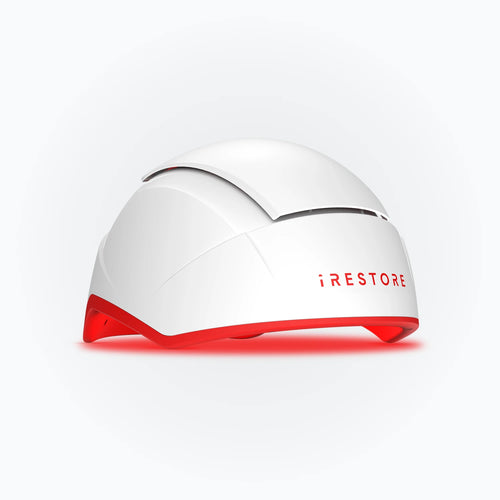
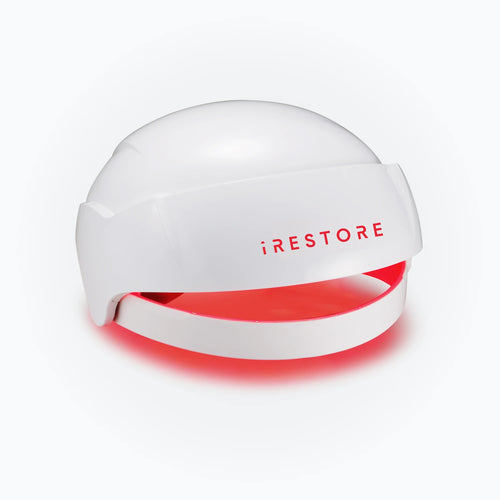
iRESTORE Essential and Professional use 655nm, while Elite combines 625nm, 655nm, and 680nm. Its use across hair-growth systems makes 655nm a relevant specification, but current evidence does not establish it as universally superior to nearby wavelengths such as 650nm or 660nm.
Why Does Wavelength Matter in Photobiomodulation?
Photobiomodulation uses specific wavelengths of visible or near-infrared light to produce photochemical responses in biological tissue. Wavelength matters because different wavelengths interact differently with tissue, while treatment effects also depend on factors such as light dose, exposure time, and device design.
What Role Does Cytochrome c Oxidase Play?
Cytochrome c oxidase is one of the most widely studied proposed photoacceptors in photobiomodulation. It is part of the mitochondrial electron transport chain and may help explain how absorbed light influences cellular energy production and signaling. However, researchers continue to study other pathways involved in PBM, so it should not be presented as the only mechanism.
How Can Red Light Affect the Hair-Growth Cycle?
Hair follicles move through anagen, catagen, and telogen phases. In a 2021 laboratory study using cultured human hair follicles, 650nm red light increased follicular-cell proliferation and delayed the transition from anagen to catagen.
These laboratory findings provide a plausible mechanism for how red light may influence follicular activity, but they should not be interpreted as proof that every resting follicle will respond or that PBM works equally well for every cause of hair loss.
Tissue penetration also varies with wavelength, tissue composition, pigmentation, scattering, and device output. Longer wavelengths generally penetrate tissue differently and often more deeply than shorter visible wavelengths, but greater penetration should not be treated as evidence of greater hair-growth effectiveness. The relevant question is whether a device delivers an appropriate light dose to its intended follicular target.
What About 850nm? A Different Wavelength for a Different Purpose
850nm is a near-infrared wavelength, but it is not used in iRESTORE hair-growth devices. iRESTORE Essential and Professional use 655nm, while Elite uses 625nm, 655nm, and 680nm. This distinction matters because shoppers should not assume that a higher wavelength number or deeper tissue penetration makes a device better suited for hair growth.
Near-infrared light interacts with tissue differently from visible red light and is commonly used in photobiomodulation applications where deeper tissue exposure is relevant. iRESTORE uses 850nm in body-focused devices such as Flex, Apex, and Sculpt, rather than in its hair-growth systems.
This does not mean 850nm has no role in photobiomodulation. It means its use in iRESTORE body devices should not be interpreted as a specification or recommendation for Essential, Professional, or Elite hair-growth systems. For hair-device selection, the intended application and evidence supporting the complete device matter more than choosing the deepest-penetrating wavelength.
What Should You Look for in a Red Light Therapy Device for Hair?
Wavelength is only one part of a photobiomodulation system. When comparing devices, consider the complete treatment design and the evidence supporting its intended use.
-
Wavelength: Look for wavelengths supported by hair-growth research or clinical evidence for the specific system. Visible-red wavelengths in the mid-600nm region appear frequently in LLLT studies, but wavelength alone does not validate a product.
-
FDA clearance and intended use: FDA clearance applies to a complete device for a specified intended use. It should not be interpreted as FDA validation of an isolated wavelength.
-
Scalp coverage and light delivery: Diode count can contribute to coverage, but more diodes alone do not prove better results. Placement, light output, and overall device design also matter.
-
Treatment protocol: Follow the schedule specified for the individual device rather than assuming every system uses the same session duration or frequency.
Consistency matters, but following a treatment schedule does not guarantee the same response for every user.
What Wavelengths Do iRESTORE Hair-Growth Devices Use?
iRESTORE hair-growth devices use visible-red wavelengths in the same general region discussed throughout this article. The specific wavelengths vary by model, so shoppers should compare the full device rather than assume every iRESTORE system uses the same configuration.
-
iRESTORE Essential: 655nm
-
iRESTORE Professional: 655nm
-
iRESTORE Elite: 625nm, 655nm, and 680nm
None of iRESTORE's hair-growth devices use 850nm. That wavelength appears in selected iRESTORE body devices, where it serves a different intended application.
What iRESTORE Customers Say
Seeing is believing and when it comes to red light therapy, the results speak for themselves.
Across thousands of users, consistent use over several months has led to stronger, fuller, and healthier-looking hair, visible in both real photos and clinical trials.
Alyssa, 34 - Widening Parts
“Tired of my widening part, I tried this device. Six months later, my hair is stronger and thicker. Worth every penny!”
In just 6 months, Alyssa noticed visible improvement in her part line, reduced breakage, and a healthier scalp environment that supported new hair growth.

Albert, 37 - Thinning Crown
“I’ve been using the device for six months. I’m seeing significant growth in my crown. Keep up the routine and you’ll see growth!”
Albert’s consistency paid off - the crown area, typically slow to respond, showed clear thickening and coverage within 6 months.

Emma, 48 - Bald Spots
“I’ve consistently used the device for 18 months. Massive growth! As long as you are consistent, the results will come!”
Emma’s results reflect long-term dedication. Over 18 months, she saw steady filling in previously sparse areas, proving that consistency is the key to success.

iRESTORE is trusted by 600K+ customers and has more than 32,000 reviews across iRESTORE, Amazon, and Google as of August 2026.
Choose the Right Red Light Therapy Device for Your Hair
The best device is not necessarily the one with the highest wavelength number. Look for a hair-growth system with relevant clinical support, appropriate scalp coverage, a clear treatment protocol, and specifications suited to its intended use.
Explore the iRESTORE Hair Growth Systems to compare the available options and choose the system that best fits your treatment needs.
Key Takeaways
|
Frequently Asked Questions
Q1. How long does red light therapy take to work for hair growth?
A1. Hair-growth changes from low-level light therapy are generally evaluated over months rather than after a few sessions. The expected timeline depends on the device, treatment protocol, underlying cause of hair loss, and individual response, so users should follow the instructions for their specific system.
Q2. Can you use red light therapy with minoxidil?
A2. Red light therapy and topical minoxidil have been studied both separately and in combination for androgenetic alopecia. People using minoxidil or other hair-loss treatments should follow product directions and speak with a healthcare professional if they are unsure how to combine treatments safely.
Q3. Does red light therapy work for every type of hair loss?
A3. No. Much of the clinical evidence for hair-growth photobiomodulation focuses on androgenetic alopecia, also called pattern hair loss. Sudden, patchy, scarring, or unexplained hair loss can have different causes and should be evaluated by a qualified healthcare professional.
Q4. Can red light therapy cause temporary hair shedding?
A4. Some people may notice temporary shedding when starting certain hair-growth treatments, but shedding is not a guaranteed response to red light therapy. If hair loss suddenly worsens, becomes patchy, or continues beyond the expected adjustment period, a healthcare professional can help rule out other causes.
Disclaimer: The iRESTORE blog is for informational purposes only and is not intended to replace professional medical advice or treatment. Please do not ignore professional guidance because of information you’ve read here. If you have concerns about your hair or skin health, we encourage you to consult a qualified healthcare professional.