

Postpartum hair loss, also called postpartum telogen effluvium, is a temporary increase in hair shedding that commonly begins a few months after childbirth. This type of hair loss after pregnancy usually reflects a normal shift in the hair-growth cycle and does not mean the follicles are permanently damaged.
Shedding often becomes most noticeable around four months postpartum, then gradually eases as new growth returns over the following months.
What Causes Postpartum Hair Loss?
Postpartum hair loss occurs because the hair growth cycle shifts after pregnancy. During pregnancy, hormonal changes can keep more hairs in the anagen, or growth, phase for longer than usual. After childbirth, hormone levels shift, and a larger number of hairs can enter the telogen, or resting, phase around the same time.
Those hairs do not fall out immediately. They remain in the resting phase before shedding, which is why increased hair loss often appears a few months after delivery rather than right after birth. Dermatologists call this type of excessive shedding telogen effluvium.
In postpartum telogen effluvium, the shedding is usually diffuse rather than limited to one sharply defined area. The follicles are still present, so the condition is generally temporary rather than a form of scarring hair loss.
Postpartum hair loss is also sometimes described as postpartum alopecia, although postpartum telogen effluvium more precisely describes the temporary shedding process.
What Can Make Postpartum Hair Shedding Worse or Last Longer?
The postpartum hair-cycle shift is the main trigger, but iron deficiency or anemia, thyroid dysfunction, major physical stress, restrictive dieting, or another nutritional deficiency can contribute to additional or persistent shedding. These factors do not cause normal postpartum telogen effluvium itself.
Postpartum thyroiditis is one condition worth ruling out when hair loss occurs with symptoms such as unusual fatigue, changes in weight, heart-rate changes, or heat or cold intolerance. A healthcare professional can determine whether thyroid testing, iron studies, or other blood tests are appropriate.
The American Thyroid Association estimates that postpartum thyroiditis affects about 5% to 10% of women in the United States.
Does Breastfeeding Cause Postpartum Hair Loss?
Breastfeeding is not considered the primary cause of postpartum hair loss. The main trigger is the change in the hair cycle that follows pregnancy and childbirth, so postpartum shedding can occur regardless of how a baby is fed.
Some research has found an association between longer breastfeeding duration and postpartum hair loss, but that does not establish breastfeeding itself as the cause. A 2023 observational study of 331 women found that longer breastfeeding duration was associated with postpartum hair loss, but the study could not determine that breastfeeding directly caused the shedding. Postpartum shedding alone is not a reason to stop breastfeeding.
When Does Postpartum Hair Loss Start and How Long Does It Last?
Postpartum hair loss usually becomes noticeable a few months after delivery, often peaks around four months postpartum, and gradually improves over the following months. The American Academy of Dermatology notes that most women regain their normal hair growth by their child’s first birthday.
|
Time After Delivery |
What May Be Happening |
What You May Notice |
|
0–2 months |
The hair cycle is beginning to adjust after pregnancy |
Little or no obvious increase in shedding |
|
2–4 months |
More resting-phase hairs begin to shed |
More hair in the shower, brush, on clothing, or around the home |
|
Around 4 months |
Shedding is often at its most noticeable |
Diffuse thinning may become easier to see, especially near the hairline |
|
5–8 months |
Shedding commonly begins to ease |
Less daily hair loss and short regrowing hairs may start to appear |
|
8–12 months |
Hair continues through the regrowth cycle |
Density and fullness gradually improve |
|
Around 12 months and beyond |
Most women have regained their usual hair growth or fullness |
Persistent or worsening loss may need medical evaluation |
This timeline is a general guide rather than a fixed schedule. Some women notice shedding earlier or later, and recovery can vary depending on overall health and other factors affecting the hair cycle.
The most useful benchmark is the overall direction of recovery. Shedding should generally become less noticeable over time rather than continue worsening.
Can You Stop Postpartum Hair Loss? What Actually Helps
There is no proven way to stop normal postpartum telogen effluvium once the shedding cycle has started. Instead, focus on supporting overall hair health, reducing avoidable breakage and traction, and identifying any medical or nutritional issue that may be contributing to continued loss.
Eat Enough Protein and Correct Confirmed Nutrient Deficiencies
Adequate nutrition matters during postpartum recovery, especially when the body is also recovering from pregnancy and delivery. Protein is particularly important because hair fibers are largely made of keratin, a structural protein.
Iron status may also deserve attention in some women, particularly after substantial blood loss during delivery or when symptoms of anemia are present. Other nutrient deficiencies can contribute to hair loss, but taking supplements without knowing that a deficiency exists is unlikely to address the underlying postpartum hair-cycle shift.
If a deficiency is suspected, testing can help determine whether targeted supplementation is appropriate. Speak with your healthcare provider before starting a new vitamin, mineral, or hair-growth supplement while breastfeeding.
Protect Hair From Breakage and Traction
Postpartum telogen effluvium occurs at the follicle level, so changing your shampoo or hairstyle cannot stop the shedding itself. Gentle haircare can, however, reduce additional breakage and make temporarily thinner hair easier to manage.
Useful adjustments include:
-
Avoid very tight ponytails, buns, braids, or extensions that repeatedly pull on the hair.
-
Handle wet hair gently and avoid aggressive brushing or detangling.
-
Limit frequent high-heat styling if your hair feels dry or fragile.
-
Limit harsh chemical treatments when they are causing noticeable breakage.
-
Choose lightweight conditioners that do not weigh down fine or temporarily thinner hair.
The American Academy of Dermatology also recommends volumizing shampoo and conditioners formulated for fine hair to help postpartum hair appear fuller while shedding runs its course. These products can improve appearance, but they do not change the underlying shedding process.
Be Cautious With Biotin and “Hair Growth” Supplements
Biotin is frequently marketed for thinning hair, but taking more biotin does not necessarily lead to more hair growth. A review of the relationship between nutrition and hair loss found no clinical trials demonstrating that biotin supplements improve hair loss in people who do not have a biotin deficiency.
High-dose biotin also has an important downside. The U.S. Food and Drug Administration warns that biotin in dietary supplements can interfere with certain laboratory tests and produce incorrect results. This matters if blood testing becomes part of an evaluation for persistent postpartum symptoms.
Instead of adding several hair-growth supplements at once, focus on a balanced diet and ask your healthcare provider whether testing or targeted supplementation is appropriate for you.
When Should You See a Doctor About Postpartum Hair Loss?
Most postpartum shedding improves without medical treatment, but some patterns deserve professional evaluation.
Medical evaluation is especially appropriate if:
-
your hair has not returned toward its usual fullness by around one year postpartum
-
hair loss appears in clearly defined patches rather than as diffuse shedding
-
thinning becomes progressively more noticeable along the part or crown
-
your scalp develops redness, scaling, pain, inflammation, or signs of scarring
-
you also have symptoms such as unusual fatigue, weight changes, heart-rate changes, or heat or cold intolerance
-
you have reason to suspect anemia, iron deficiency, or another nutritional problem
The American Academy of Dermatology advises seeing a dermatologist if normal hair fullness has not returned by about one year after childbirth, because another cause of hair loss may be contributing.
A clinician can review the pattern of loss, your medical history, and any accompanying symptoms to determine whether further testing is appropriate.
Can Postpartum Hair Loss Reveal Female Pattern Hair Loss?
Sometimes, postpartum shedding makes a previously subtle hair-loss condition easier to notice. This does not mean postpartum telogen effluvium causes female pattern hair loss. Instead, the temporary increase in shedding can reveal underlying androgenetic alopecia that was less obvious before or during pregnancy.
A 2024 study examining women with postpartum telogen effluvium found that some also had androgenetic alopecia or traction alopecia. The study supports the idea that postpartum shedding can coexist with other hair-loss conditions, but it does not mean persistent postpartum hair loss is automatically androgenetic alopecia.
Postpartum Telogen Effluvium vs. Androgenetic Alopecia
The pattern and course of hair loss can provide useful clues, although a dermatologist should make the diagnosis.
|
Feature |
Postpartum Telogen Effluvium |
Androgenetic Alopecia |
|
Typical pattern |
Diffuse shedding across the scalp |
More patterned, progressive thinning |
|
Course |
Increased shedding after childbirth |
Usually develops gradually |
|
Expected course |
Usually improves as postpartum shedding resolves |
May persist or progress over time |
|
Follicle process |
Temporary shift in the hair cycle |
Progressive follicle miniaturization |
|
Common clue |
Increased diffuse shedding |
Widening part or persistent crown thinning |
|
Next step |
Monitor recovery and evaluate unusual persistence |
Dermatologic assessment |
Family history can add context, but it is not enough to confirm androgenetic alopecia on its own. Persistent widening of the part, progressive crown thinning, or hair density that does not recover as expected are stronger reasons to seek an assessment.
How Is Persistent Postpartum Hair Loss Evaluated?
A dermatologist will usually review when shedding started, how it has changed, and whether the loss is diffuse or patterned. Examination of the scalp and hair can provide important clues, and trichoscopy may help assess follicle and shaft patterns.
Blood tests may be considered when symptoms or medical history suggest iron deficiency, thyroid dysfunction, or another systemic contributor. Scalp biopsy is generally reserved for cases in which the diagnosis remains uncertain.
What About Minoxidil or Red Light Therapy for Postpartum Hair Loss?
Treatments used for other types of hair loss are not automatically treatments for postpartum telogen effluvium.
Because typical postpartum shedding usually improves as the hair cycle recovers, treatments such as minoxidil or low-level laser therapy need to be considered in the context of the type of hair loss a person actually has.
Minoxidil
Minoxidil is commonly used for pattern hair loss, but it is not a standard treatment for uncomplicated postpartum telogen effluvium. If postpartum shedding follows the expected course, medication is often unnecessary.
Breastfeeding also requires a more individualized discussion. The NIH Drugs and Lactation Database states that topical minoxidil is considered acceptable once breastfeeding is established, while oral minoxidil warrants greater caution, particularly when breastfeeding a newborn. It also advises preventing an infant from contacting skin treated with topical minoxidil.
If you are considering minoxidil while breastfeeding or because your hair is not recovering as expected, speak with your dermatologist or OB/GYN before starting treatment.
Red Light Therapy and Low-Level Laser Therapy
Low-level laser therapy (LLLT), also called photobiomodulation, uses specific wavelengths of light and has been studied as a non-drug treatment for androgenetic alopecia. However, current evidence does not establish LLLT as a treatment for acute postpartum telogen effluvium.
That distinction matters because most LLLT hair-growth studies involve people with androgenetic alopecia rather than women experiencing normal postpartum shedding. A 2026 prospective, open-label study followed 68 people with androgenetic alopecia who used a home LLLT device emitting 646–675 nm light for 48 weeks. Mean hair density increased from 99.2 to 124.2 hairs/cm² by week 48.
The study supports the use of LLLT for androgenetic alopecia, but it does not show that red light therapy stops postpartum telogen effluvium or speeds normal postpartum recovery. This is why identifying the type of hair loss matters before choosing a treatment.
Where iRESTORE May Fit If Androgenetic Alopecia Is Diagnosed
If a dermatologist identifies androgenetic alopecia alongside or after postpartum shedding, LLLT may become a relevant treatment option because its clinical evidence applies to AGA rather than normal postpartum telogen effluvium.
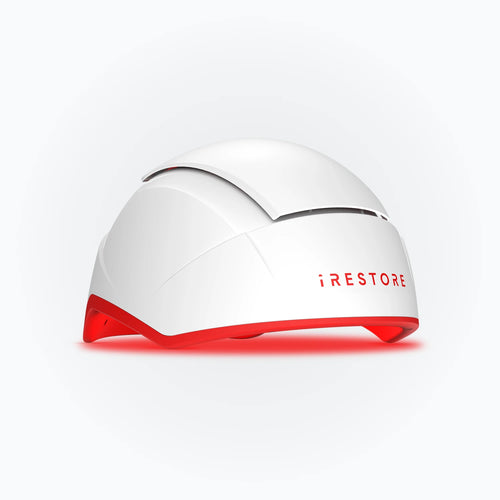
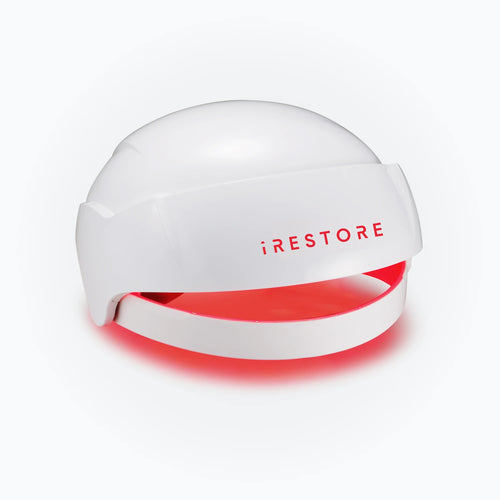
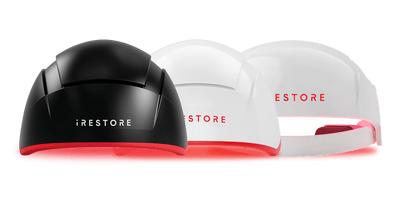
iRESTORE offers several at-home LLLT systems for hair growth.
The Essential uses 120 diodes at 655 nm, while the Professional uses 282 diodes at 655 nm. The Elite uses 500 diodes across 625, 655, and 680 nm wavelengths.
The Elite has separate FDA 510(k) clearance, with FDA documentation listing its 625, 655, and 680 nm wavelengths.
The key point is that treatment should follow diagnosis. If postpartum shedding has resolved but patterned thinning remains, a dermatologist can determine whether androgenetic alopecia is part of the picture and whether LLLT is appropriate.
Key Takeaways
|
Frequently Asked Questions
Q1. How much hair shedding is normal after having a baby?
A1. Postpartum shedding can be noticeably heavier than your usual daily hair loss, especially when washing or brushing. An exact hair count is less useful than the overall pattern. Diffuse shedding that gradually eases is more typical of postpartum telogen effluvium than hair loss that keeps worsening or becomes patchy.
Q2. Why is postpartum hair loss often more noticeable around the hairline?
A2. Postpartum shedding occurs across the scalp, but thinning can look more obvious around the temples and front hairline because these areas are highly visible and short regrowing hairs are easier to notice there. A clearly defined bald patch, however, is not typical of postpartum telogen effluvium and should be assessed by a dermatologist.
Q3. Does postpartum hair grow back differently?
A3. New growth may first appear as short hairs around the hairline or part, which can temporarily make the texture or shape of your hair look different. This usually reflects hairs growing at different lengths rather than a permanent change in hair type.
Q4. Can postpartum hair loss happen after every pregnancy?
A4. Yes, postpartum hair loss can occur after more than one pregnancy, but the timing and severity may differ each time. Changes in overall health, stress, nutrition, and the individual hair cycle can influence how noticeable the shedding becomes.
Disclaimer: This article is for informational and educational purposes only and is not intended to provide medical advice, diagnosis, or treatment. Postpartum hair loss can have several contributing factors, and individual recovery timelines vary. If you are concerned about persistent, patchy, worsening, or otherwise unusual hair loss, consult a dermatologist, OB/GYN, or other qualified healthcare professional. Speak with your healthcare provider before starting any medication, supplement, or hair-loss treatment, particularly during pregnancy or while breastfeeding.